Live · Multi-modal SDA engine

Watch every object in low Earth orbit. Catch the anomaly before it catches you.

DebrisGuard fuses four independent detectors (orbital-element anomaly, RF carrier classification, optical streak detection, ViT object anomaly) into one trustable score for every object on orbit. Built for satellite operators who can't afford a surprise.

From $0 · Watcher tier always free · Self-serve in < 5 min →
30 896
Objects scored last cycle
1,667
Burns flagged · last 14 d
74.6%
Post-TLE confirmation rate
Decay watch · 45-day lead · n_pos = 522
Detailed view of a satellite constellation in low Earth orbit: rim-lit Earth with city lights, multiple satellites, an orange conjunction warning between two converging spacecraft, a propellant burn arc from a manoeuvring satellite, and a small debris cloud drifting along an orbital lane
Live · Autopilot GREEN · last cycle today
Built on the data sources operators already trust
Space-Track
Celestrak
SatNOGS
DISCOSweb
RadioML 2018
Live · last 14 days · prod

Proven on real production traffic, not slideware.

1,667
Manoeuvres flagged
across 821 active satellites · 14-day rolling window
74.6%
Confirmation rate
1,243 of 1,667 burns settle on post-burn TLE convergence
30,896
Objects re-scored every cycle
Space-Track + Celestrak public catalogue · daily
0.91AUC
BSTAR-drift early decay
n_pos = 522 · 95% CI 0.88–0.92 · reproducible harness
Per-class noise floors (LEO 1.5e-4, MEO 3e-5, GEO 1e-5 rev/d) filtered 43,625 noise events down to 1,667 real burns. No marketing rounding. See the benchmark →
Why DebrisGuard wins

The only SDA platform your insurer can re-verify.

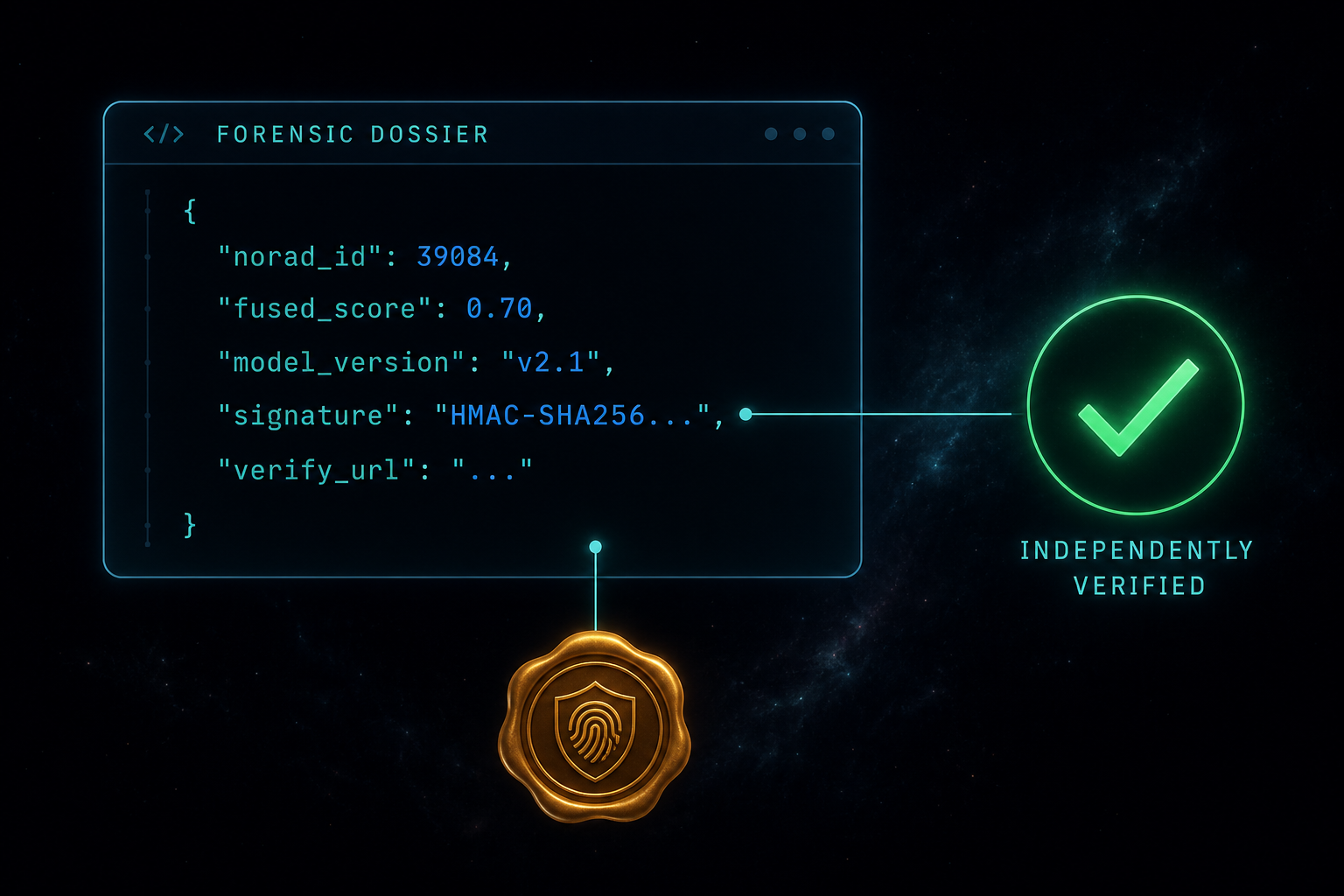
Every alert ships with its inputs, model version, and a public verification URL. That is the same evidence chain a regulator or insurance underwriter would demand, built in from day one rather than assembled after the fact.

DebrisGuard forensic dossier: JSON alert with HMAC signature, model version, and verify_url next to a terminal running 'dgb verify' to reproduce the score on a laptop
100%
Independently verifiableHMAC-signed dossier on every alert. Recompute the score on your own laptop with a single command.
0.91
BSTAR-drift AUC · 45-day horizonn_pos = 522 · 95 % CI [0.88, 0.92] · published harness, re-runs on demand.
$0 → $299
Self-serve in < 5 minWhat primes charge $50 k+/yr for. Free tier is real product, not a demo.

Built for the three questions insurers ask

  • "How did you know?" Fused score breakdown by detector.
  • "On what data?" The exact TLE pair, by reference and timestamp.
  • "Is the chain intact?" HMAC signature, recomputable.

Mission Control tier retains the document for 2 years, so the dossier still verifies when a claim hits adjusters in 2028.

2 yrforensic retention on Mission Control

1 % of the price of a sensor prime

LeoLabs and Slingshot start at $50 k+/year, sales-led, with a 6-week cycle. DebrisGuard starts at $0 (Watcher) → $299/mo (Analyst), self-serve, on the same public-catalog inputs.

Capability gap on what most operators actually need: close to zero. Cost gap: 99 %. The receipt model + the price point are why brokers and underwriters take the call.

99%cost-gap vs the sensor primes (apples-to-apples)

Capability matrix · what an SDA buyer actually asks for

Live numbers, not asserted ones · see the benchmark →
Capability
LeoLabs · Slingshot
Space-Track · Celestrak
DebrisGuard
Manoeuvre detection on public TLEs
Premium add-on
DIY in Python
Built-in · published rate
Early-decay watch with published ROC-AUC
~Implicit · not published
No
0.91 AUC · n=522 · reproducible
HMAC-signed forensic dossiers
PDFs only
No
Share by URL · re-verifiable
Public, reproducible benchmark
No
No
Cosmos 1408, Iridium-Cosmos
Self-serve sign-up (no sales call)
6-week cycle
~Form + approval
Cognito + Stripe · <5 min
Webhook to Slack / Teams
~Custom integration $$
No
Built-in (Operator+)
Entry price · 5-satellite operator
$50 k+ / yr
$0 · no UX
$0 → $299 / mo
Worked example

60 seconds with DebrisGuard.

Here's a real burn DebrisGuard caught overnight on LANDSAT 8 (NORAD 39084). Three tiles: what the public catalog showed, what our fused score flagged, and the operator advice we shipped.

Public catalog

15.51

Mean motion (rev/day) on the latest TLE looks nominal. Decay roster: not listed. CDM screen: clear.

What an operator would see on Space-Track alone.

DebrisGuard fused

0.70 amber

Catalog modality and manoeuvre detector both fired. Burn: +2.6×10⁻⁴ rev/d, z = 50. Surfaced on the next nightly cycle, before the next routine CDM screen against a stale orbit.

Four-detector ensemble fused via noisy-OR.

Recommended action

Phasing burn. Re-screen conjunctions for the next 48 h.

Auto-routed into the operator's daily digest. Click the signed dossier above for the full HMAC-verifiable evidence chain (inputs, model versions, contributing modalities).

Every alert ships with this advice.
Why it matters: the public catalog is silent on burns of this size until the next routine TLE lands (typically 12 to 48 hours). By then a CDM may already have been issued against a stale orbit. DebrisGuard surfaces them on the next nightly cycle so your ops team can re-screen before the next CDM lands. Open the signed dossier →
Four detectors. One score.

Multi-modal anomaly detection.

No single sensor catches every kind of orbital anomaly. DebrisGuard fuses up to four detectors with a noisy-OR weighted geometric mean, so corroborating signals reinforce each other while lone false alarms get dampened. Two detectors are live in production today, three with the v1.1 optical pipeline.

Catalog anomaly (snapshot) Live

Per-orbit-class Mahalanobis distance over the six classical elements. Catches out-of-family launches, fragmentations, and gross orbit departures against a 30 000-object reference catalog. The snapshot view — pair it with the BSTAR-drift card below for the time-series view.

30 000+ ref objects · per-class χ2 · nightly

BSTAR-drift early-decay watch Live · validated

Time-series fit of BSTAR + mean-motion slopes against the per-orbit-class envelope. Catches LEO objects whose drag is ramping up — the early signal of re-entry, weeks before 18 SDS publishes a decay warning.

45-day AUC 0.91 [0.88-0.92] · n_pos = 522 · verify on benchmark

RF carrier classification Live (beta)

1-D CNN on IQ samples covering 24 modulation classes from RadioML 2018.01A. Surfaces unexpected emitters, hijacked uplinks, and unidentified transmissions on SatNOGS passes.

top-1 48 % · macro-F1 0.43 · 24 classes

Optical streak detection Roadmap v1.1

YOLOv8 on TLE-anchored synthetic frames. Picks moving objects out of star-fixed exposures with sub-pixel localisation. Holds the v1.1 release until the optical capture pipeline finishes its cost review.

mAP50 0.995 (synthetic) · P 0.99 · R 0.99

ViT object anomaly Roadmap v1.1

Frozen DINO ViT-B/16 with Mahalanobis on 768-d CLS embeddings. Flags optical cutouts that don't look like anything in the known fleet (fragmentation events, deployed payloads, attached debris). Ships alongside the optical pipeline in v1.1.

AUC 0.995 (held-out) · recall@1 %FPR 100 %
From raw data to one alert

The pipeline.

Each nightly cycle ingests the public catalogue, runs every detector independently, fuses the results, signs the dossier, and routes only the signals that clear the consensus threshold into your dashboard, daily digest, and webhooks.

DebrisGuard live encounter view: a fleet satellite (NORAD 25544) on a cyan orbital track and a piece of debris on a red track converging at a T-minus 2-minute 14-second close approach with 480 m miss distance. A mint-green manoeuvre-advice vector shows the recommended ΔV 0.18 m/s evasive burn at 92 % confidence. Below the scene, the five-stage pipeline that produced the advice: INGEST (TLE / OMM, 30k+ objects) → FUSE (range-rate, ephemeris-delta, RFI gate) → SCORE (BSTAR-drift, 0.91 ROC-AUC) → CLASSIFY (Burn / Drift / RFI, confidence ≥ 0.7) → ADVISE (1,667 manoeuvres flagged in the last 14 days, 74.6 % confirmed).
One live encounter, one burn recommended, full pipeline trace attached. Same engine running in production now.
30,896objects re-scored each cycle
1,667manoeuvres flagged · last 14 days
74.6%post-TLE confirmation rate
0.91BSTAR-drift AUC · n = 522
Why fusion matters

One signal lies. Four signals don't.

Every individual detector has blind spots. A catalog-only system misses fragmentation events until the cloud spreads enough to register. An optical-only system goes blind in cloud cover. RF-only misses passive debris. ViT-only confuses real objects with image artefacts.

DebrisGuard fuses the available detectors into a single score using a noisy-OR weighted geometric mean. Corroborating evidence drives confidence up. A single noisy detector cannot trigger a false alarm on its own.

  • Calibrated per modality. Each detector is normalised to a 0 to 1 anomaly probability before fusion. No single sensor can dominate.
  • Explanations included. Every alert ships with the per-modality breakdown, so your analysts know why the score is what it is.
  • Tunable per asset. Custom thresholds and per-NORAD playbooks on Operator tier and above.
Anomaly alert visualization with multi-modal score breakdown
Fleet monitoring

Your constellation, at a glance.

Pin every NORAD ID you care about to a watchlist. Each asset gets a health pill on the dashboard: green when the fused score is below threshold, amber when one detector is degraded, red when consensus fires.

The same Autopilot that watches our own engine watches yours. Every nightly cycle is logged, every verdict is explained, and stability streaks are tracked so you know when to trust the silence.

  • Up to 250 NORAD assets on Mission Control. Unlimited on Institutional.
  • Per-asset alert thresholds and on-call escalation playbooks.
  • Rolling HTML dashboard safe to embed in your NOC display. Read-only views need no auth.
Fleet monitoring grid showing satellite health pills
Operator console

The dashboard your NOC will keep open.

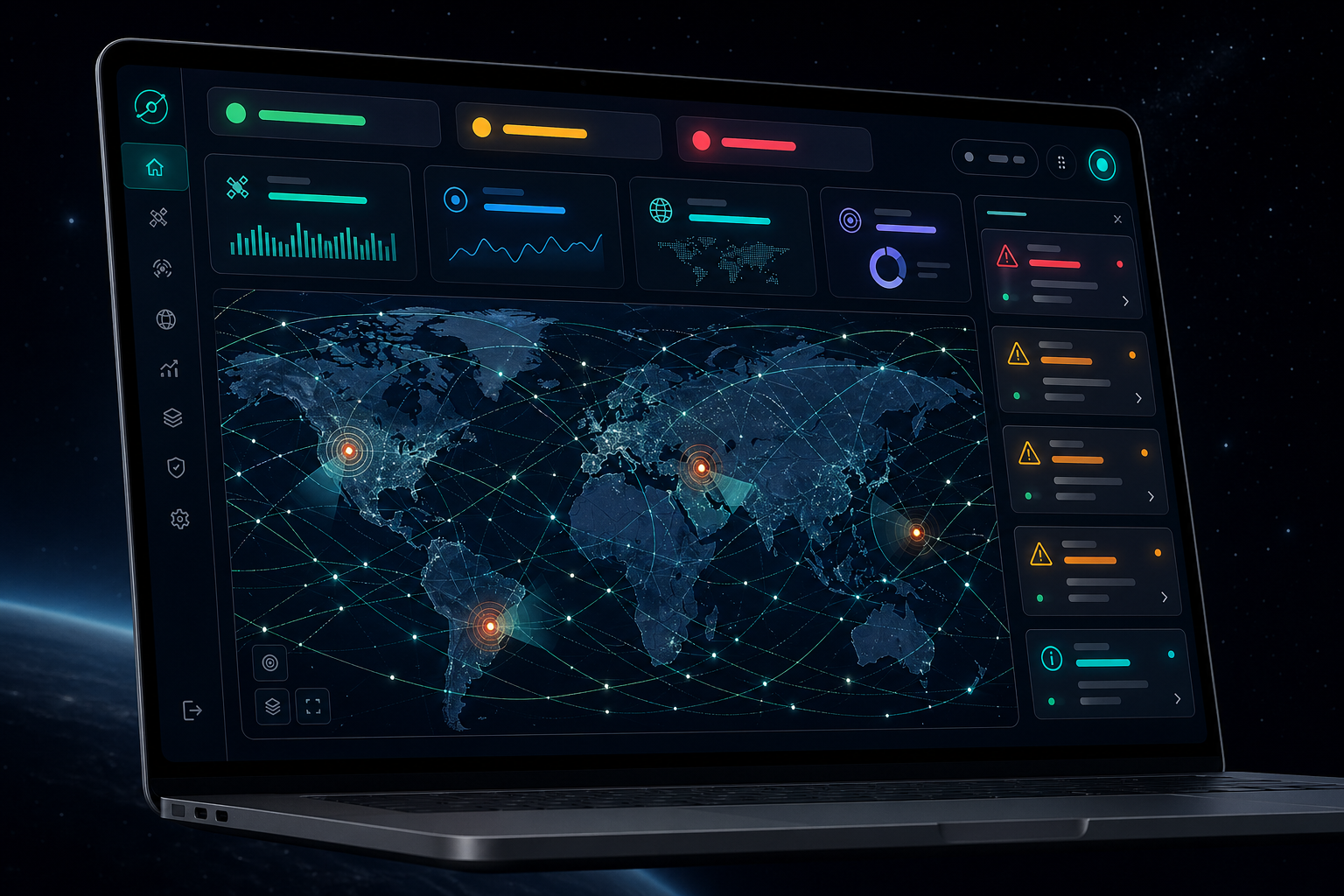
Live anomaly map of every object scored in the latest cycle. Per-detector status pills. Streaming alert column. Click any object for the full multi-modal score breakdown, the underlying TLE, the optical cutout (when v1.1 lands), and the orbit ground-track.

Embed read-only views into any internal status page. Same dashboard pattern that runs the DebrisGuard Autopilot itself.

Open the dashboard
DebrisGuard live dashboard preview
Pricing

Start free. Scale to a constellation.

Every tier ships only features we operate today. No aspirational line items, no surprise upcharges. All prices in USD, billed monthly, cancel any time.

Watcher
Hobbyists, students, curious minds.
$0
Forever free
  • Live anomaly dashboard (read-only)
  • 10 catalog object lookups per day via REST API
  • Latest daily anomaly report (HTML + JSON)
  • 1 NORAD ID on personal watchlist
  • Read-only forensic dossiers (HMAC-signed)
  • Community support via GitHub issues
Operator
Small satellite operators and integrators.
$1,499/mo
Billed monthly
  • Everything in Analyst
  • REST API at 300 req/min, 50 000 lookups/day
  • 25 NORAD watchlist with custom per-asset thresholds
  • Fused multi-modal scoring (catalog + RF live; optical + ViT in v1.1)
  • 90-day rolling report history
  • Manoeuvre advice on every burn (operator-readable action text)
  • Priority email support, 24-hour SLA
Mission Control
Constellation operators with mission-critical fleets.
$7,999/mo
Billed monthly
  • Everything in Operator
  • REST API at 1500 req/min, unlimited lookups
  • 250 NORAD watchlist with per-asset playbooks
  • Daily Autopilot cycle with stability streak tracking
  • 2-year report and dossier retention
  • Hosted on CloudFront (99.9 % monthly uptime SLA)
  • Daily email digest plus optional read-only NOC embed
Institutional
Sovereign, mission-critical, and large-constellation deployments.
Bespoke
Engagement-led, custom commercial terms
  • Everything in Mission Control
  • Deployment in your own AWS account or sovereign cloud (case-by-case)
  • Choice of hosting region (AU, EU, US, APAC) for data residency
  • Audit logging plus chain-of-evidence dossiers (HMAC-signed)
  • Detector training and tuning on your proprietary data
  • Custom integrations (STK, COMSPOC, MCS, ground systems) on request
  • Mutual NDA and procurement-vehicle support
Working with operators and institutions

Independent. Deployable wherever your mandate lives.

DeepFieldLabs is an independent space-intelligence lab. We work with civil space programmes, national regulators, defence and security organisations, research groups, and commercial operators on bespoke terms, always under their own governance. Where required, DebrisGuard can be deployed inside your own AWS account or sovereign region, with the full source of the detection engine reviewable under NDA.

What happens next
  • We reply within one business day, AEST hours.
  • For institutional deployments, we can run a 30-minute scoping call before any commitment.
  • Submissions land in our shared mailbox via SNS, no public inbox is exposed on this site.
  • We do not add you to any marketing list. Single-thread reply only.
REST API

Three calls to a fused score.

Token-authenticated, rate-limited per tier, deployed on api.debrisguard.io/v1/*. Python SDK on the v1.1 roadmap.

  • Bearer JWT or X-API-Key. Cognito-issued tokens for browsers, hashed API keys for machines.
  • Same fused score the dashboard uses. No "API tier" dilution. What you see is what you get.
  • Daily report endpoint. /v1/reports/daily/latest returns the same JSON the dashboard renders, ready for your pipeline.
# 1. Score one catalog object end-to-end curl https://api.debrisguard.io/v1/objects/25544 \ -H "X-API-Key: $DG_KEY" # 2. Pull today's anomaly report (JSON + HTML) curl https://api.debrisguard.io/v1/reports/daily/latest \ -H "X-API-Key: $DG_KEY" # 3. Add a NORAD ID to your watchlist curl -X POST https://api.debrisguard.io/v1/fleet \ -H "X-API-Key: $DG_KEY" \ -H "Content-Type: application/json" \ -d '{"norad_cat_id":"25544","label":"ISS","threshold":0.65}'
FAQ

Questions you'll ask anyway.

What sources do you ingest?

Space-Track (GP, CDMs, decay roster, SATCAT), Celestrak (TLEs), SatNOGS (RF captures and observations), DISCOSweb (physical properties). Optical capture pipeline lands in v1.1.

How fresh is the data?

Catalog refit nightly at 00:00 UTC, scoring every active object. Per-asset scoring on demand from the API. Per-tier rate limits apply. Real-time streaming alerts are not part of v1.0; they sit on the v1.1 roadmap behind webhook delivery.

Can I see why an alert fired?

Every alert ships the full per-modality breakdown (catalog d², RF top-1 confidence, manoeuvre delta-mean-motion plus z-score, plus optical and ViT once v1.1 lands), so your analysts can audit the decision. Each forensic dossier is HMAC-signed for audit trails.

What about false positives?

The fused score requires consensus across detectors before firing. A single noisy modality cannot trigger an alert on its own. On Operator tier and above you also get per-asset thresholds so you can dial precision and recall to your own playbook.

Do you store our orbital data?

Watchlist NORAD IDs and your alert history, yes, retained per your tier's window (current cycle on Watcher, 30-day on Analyst, 90-day on Operator, 2-year on Mission Control). Raw third-party catalog data is not redistributed; you get the score, not the source feed.

Can we run it on-prem?

Institutional tier supports deployment in your own AWS account or sovereign region, on bespoke commercial terms. Air-gapped container delivery is in scope but planned per engagement (contact us for the security review).

Catch the anomaly before it catches you.

Free tier ships today. No credit card. Pin one NORAD on your watchlist in under a minute.

Try a watchlist demo